Buying Property in the USVI: A Complete Guide
A step-by-step guide to buying property in St. Thomas, St. Croix and St. John, from choosing an island to recording the deed, with the offices involved at each stage.
BuyingBy USVI Realty Editorial TeamUpdated October 28, 202611 minute read
USVI Realty is an educational resource. We do not represent buyers or sellers, list property, or give legal, tax or investment advice. This guide walks through the general process of buying property in St. Thomas, St. Croix and St. John so you know which questions to ask, which offices are involved and which licensed professionals to bring in.
Every fact comes from a source listed at the end. Where we could not confirm something, we say what to ask and whom.
Step 1: Choose an island and an area
The territory’s three main islands differ in size, population and access. In the 2020 Census, St. Thomas had 42,261 residents, St. Croix had 41,004 and St. John had 3,881. St. Croix has by far the most land, about 83 square miles, compared with about 31 on St. Thomas and about 20 on St. John.
Estimate as of October 2026. Population figures in this guide come from the 2020 Census. Land areas are rounded from the Census Bureau’s 2025 TIGER/Line files.
A few differences shape daily life and property research:
- St. Thomas is home to Charlotte Amalie, which had 8,194 residents in 2020, the most of any town or census designated place the Census Bureau lists for the territory.
- St. Croix has two towns, Christiansted and Frederiksted, but together they counted fewer than 2,300 residents in 2020. The island’s most populous Census subdistrict, Sion Farm, had 10,332.
- St. John has no airport. The National Park Service directs visitors to fly into Cyril E. King Airport on St. Thomas, then cross from Red Hook by passenger ferry or car barge. The Park Service also says two-thirds of St. John is national park.
The Census Bureau divides St. Thomas into seven subdistricts, St. Croix into nine and St. John into four. Our island guides introduce each island: start with St. Thomas, St. Croix and St. John, or compare the two largest in St. Thomas vs. St. Croix.
Learn how estates work
Estate names are part of everyday USVI addresses, as in “3500 Estate Richmond” in Christiansted. The Census Bureau says estate names and boundaries are in common use by residents and in government administration. It adds that estate boundaries are primarily those of the former agricultural plantations that existed when Denmark transferred the islands to the United States in 1917.
The Census also notes that its boundary files are for statistical purposes only and are not legal land descriptions. Rely on the deed, the recorded survey and your title work for the exact parcel. Our guide to estates explains more.
Step 2: Line up financing or proof of funds
If you plan to borrow, the Consumer Financial Protection Bureau (CFPB) explains that a prequalification or preapproval letter shows a lender’s general willingness to lend up to a set amount. These letters are not guaranteed loan offers, but they give a seller confidence that you can get financing. After you apply, the lender must give you a Loan Estimate within three business days. All lenders use the same standard form, which makes offers easier to compare.
The Federal Housing Finance Agency (FHFA) sets conforming loan limits for mortgages that Fannie Mae and Freddie Mac acquire, with higher limits for the USVI under special statutory provisions.
Estimate as of October 2026. For 2026, FHFA set the baseline conforming loan limit for one-unit properties in the U.S. Virgin Islands at $1,249,125, compared with $832,750 in most of the United States.
Questions for lenders:
- Do you lend on this island and on this type of property (a condominium, a house or land)?
- What insurance will you require before closing, including windstorm and flood coverage?
- When will you order the appraisal, and how long does it usually take?
If you are paying cash, ask your real estate professional what proof of funds sellers expect to see with an offer.
Step 3: Work with licensed professionals
Real estate brokers and salespersons are licensed through the Virgin Islands Real Estate Commission, part of the Department of Licensing and Consumer Affairs (DLCA). The Commission’s rules say every salesperson must be licensed under a broker, that brokers and salespersons must carry their pocket cards at all times and that licenses expire on December 31 of the year issued. DLCA also offers an online License Search where you can look up licensed businesses by name, license number or island.
Two of its rules are worth knowing:
- A broker may not accept compensation from more than one party to a transaction without the full knowledge of all parties. Ask early whom your agent represents and how they are paid.
- A broker or salesperson should recommend that each purchaser retain an attorney to pass upon the marketability of the title and the other legal questions involved.
Plan on a team. It can include a USVI real estate attorney, a lender, a home inspector, a licensed land surveyor, an appraiser, a title company and a licensed insurance producer. DLCA lists separate boards for real estate appraisers and for architects, engineers and land surveyors. The Lieutenant Governor’s Division of Banking, Insurance and Financial Regulation licenses and regulates insurance companies and insurance producers.
Step 4: Make an offer and sign a contract
The Real Estate Commission’s rules require a broker or salesperson to promptly present any signed offer to the seller. Once the seller accepts and signs, copies go to the seller, the purchaser and the broker. The rules also say the sales contract must include a full legal description of the property and all terms and conditions of the sale.
Your contract may call for an earnest money deposit, which the CFPB describes as a deposit a buyer pays to show good faith on a signed contract. Under the Commission’s rules, a broker who holds escrow or deposit funds must keep them in an account at a banking institution authorized to do business in the U.S. Virgin Islands and record each deposit in a journal.
Questions to settle with your attorney before you sign:
- Who holds the deposit, and under what conditions is it refundable?
- Which contingencies protect you? The CFPB notes that if your contract is contingent on a satisfactory inspection, you have the right to cancel the sale. Ask about financing, appraisal, title and insurance contingencies too.
- What are the deadlines for the inspection, survey, financing and closing?
- Which closing costs does each side pay?
Step 5: Do your due diligence
Work through each of these with your professionals.
Home inspection
The CFPB recommends scheduling a home inspection as soon as you have chosen a home and being present so the report is easier to interpret. A home inspection is different from an appraisal, but you generally need both. Ask the inspector to look closely at the roof, the cistern and anything that has been added since the home was built.
Survey and boundaries
The CFPB describes a survey as a drawing of your property showing the location of the lot, the house and any other structures. Because estate names are not legal land descriptions, ask your attorney or title company to compare the deed, any recorded survey and what you see on the ground. If no current survey exists, ask a licensed land surveyor what a new one would involve.
Title search
The Recorder of Deeds, part of the Office of the Lieutenant Governor, records property deeds, mortgages, personal liens, tax liens and other documents, and its web page links to an online search of its records. Your attorney or title company will review that history. The CFPB notes that most lenders require you to buy a lender’s title insurance policy, while an owner’s policy protects you if someone later claims an interest in the home.
Check the property taxes too. The Lieutenant Governor’s office publishes a list of delinquent real property taxes, and property with unpaid taxes can be scheduled for an auction sale or foreclosure. Ask your attorney to confirm the taxes are current before closing.
Flood zone
FEMA calls its Flood Map Service Center the official online location for all flood hazard mapping products, and it considers any place with a 1 percent or higher chance of flooding each year to be high risk. FEMA’s Community Status Book lists the Territory of the Virgin Islands as a participating community in the National Flood Insurance Program (NFIP). If the property is in a high-risk area and you borrow from a government-backed lender, FEMA says flood insurance is required.
Water and power
Many homes collect their own water. A January 2024 guide from the Department of Planning and Natural Resources (DPNR) and the U.S. Environmental Protection Agency (EPA) estimates that 90 percent of homes in the USVI have active cisterns that depend on rainwater catchment, and it notes that some homes have water delivered by truck. The guide advises that if you do not know when a cistern was last drained, cleaned and disinfected, that should be done first. EPA does not regulate household cisterns, and the guide treats routine water testing as the owner’s cost.
The Virgin Islands Water and Power Authority (WAPA) supplies electricity and water. Ask the seller for recent utility bills, whether the home is connected to public water and what backup power is in place.
Permits and planned work
DPNR’s Division of Permits issues building, plumbing, electrical, demolition, flood, mechanical and occupancy permits, among others, and inspects construction across the territory. Ask whether past additions and renovations were permitted and inspected. If you plan work near the shore, ask DPNR’s Coastal Zone Management division, whose programs include permitting, whether its review applies.
Step 6: Arrange property insurance
Start on insurance early, because it can affect both your loan and your budget. The Office of the Lieutenant Governor, which regulates insurance in the territory, gave homeowners this guidance for the 2026 hurricane season:
- You cannot buy a homeowners insurance policy once a storm has been declared.
- Do not exclude windstorm coverage.
- Avoid being underinsured by buying coverage for at least 80 percent of the replacement cost value of your home.
- If you own a condominium, the building policy belongs to the association and is subject to its board. You can buy a separate contents policy.
A 2023 bulletin from the same office says reinsurers have required insurers to reduce the wooden or mixed frame construction they cover, so owners of those homes may face non-renewal or be unable to find coverage in the admitted market. It advises buyers to ask an insurance producer about licensed insurers and surplus lines coverage.
Flood coverage is separate. FEMA notes that most homeowners insurance does not cover flood damage and that there is typically a 30-day waiting period for an NFIP policy to take effect, with exceptions such as a policy bought because a government-backed lender requires it. The Atlantic hurricane season runs from June 1 to November 30, according to NOAA’s National Hurricane Center.
Step 7: Close the purchase
If you are borrowing, the CFPB explains that your lender must give you a Closing Disclosure at least three business days before closing. Compare it line by line with your Loan Estimate.
The Recorder of Deeds notes that Act 8542 requires two witnesses, and that no notary public may serve as both a subscribing witness and the notary on a deed. Its recording requirements also say each new deed must:
- Show the name and current mailing address of the seller (the grantor) and the buyer (the grantee).
- Refer to where the prior deed can be found in the public record, such as its book, page and document number.
- Have an original, signed and notarized Sales Valuation Affidavit attached that states the actual sales price.
If a broker is involved, the Commission’s rules require the broker to give the buyer and the seller a complete, detailed closing statement of the receipts and disbursements the broker handled.
A stamp tax also applies. In a 2002 decision, the U.S. Court of Appeals for the Third Circuit quoted the Virgin Islands Code provision imposing a stamp tax on the transfer of title to real property, and noted that the Recorder of Deeds refused to record the deed in that case until the tax was paid. We found no current rate schedule published by the territorial government, so ask the Recorder of Deeds or your attorney. Our guide to the costs of buying covers the other charges.
Step 8: Record the deed
Recording puts your ownership on the public record. The Recorder of Deeds has an office at 1131 King Street, Suite 101, in Christiansted on St. Croix, and an office at 5049 Kongens Gade on St. Thomas that serves St. Thomas and St. John.
E-recording is limited to miscellaneous documents such as affidavits, assignments and mortgage releases. Original deeds and mortgages must be submitted directly to the Recorder’s office, which processes documents from 8:30 a.m. to 3:30 p.m., Monday through Friday. Ask your attorney to confirm when the deed was recorded and to send you a recorded copy.
Step 9: Set up your property tax account
Two offices under the Lieutenant Governor handle real property tax. The Office of the Tax Assessor assesses property and offers online parcel and tax bill searches, and the Office of the Tax Collector collects payments.
For tax year 2024, the office issued bills in June that were payable without added interest or penalties until August 30, 2024. If you disagree with a valuation, the office described two routes: an informal review with the Tax Assessor within 45 calendar days after the bill is issued, or a formal appeal to the Board of Tax Review.
If the property will be your primary residence, ask about the homestead tax credit. It applies only when you are the legal owner and the property is your primary residence, and you cannot claim it on more than one residence.
Estimate as of October 2026. The Tax Assessor’s published requirements list a general homestead credit of $400. Owners who qualify may add one other credit: $500 for seniors, $500 for disability or $650 for veterans. A minimum tax of $180 applies to all homestead credits.
We did not find current real property tax rates published by the territorial government, so ask the Tax Assessor which property class applies to the parcel and what the current rate is.
Next steps
Before you commit, make sure your attorney has confirmed the title and the taxes, and that you have insurance quotes, including windstorm and flood, that fit your budget. For a printable version of these steps, get our free Buyer’s Guide on the Resources page. If you are coming from the mainland, read Can U.S. Citizens Buy Property in the USVI? next.

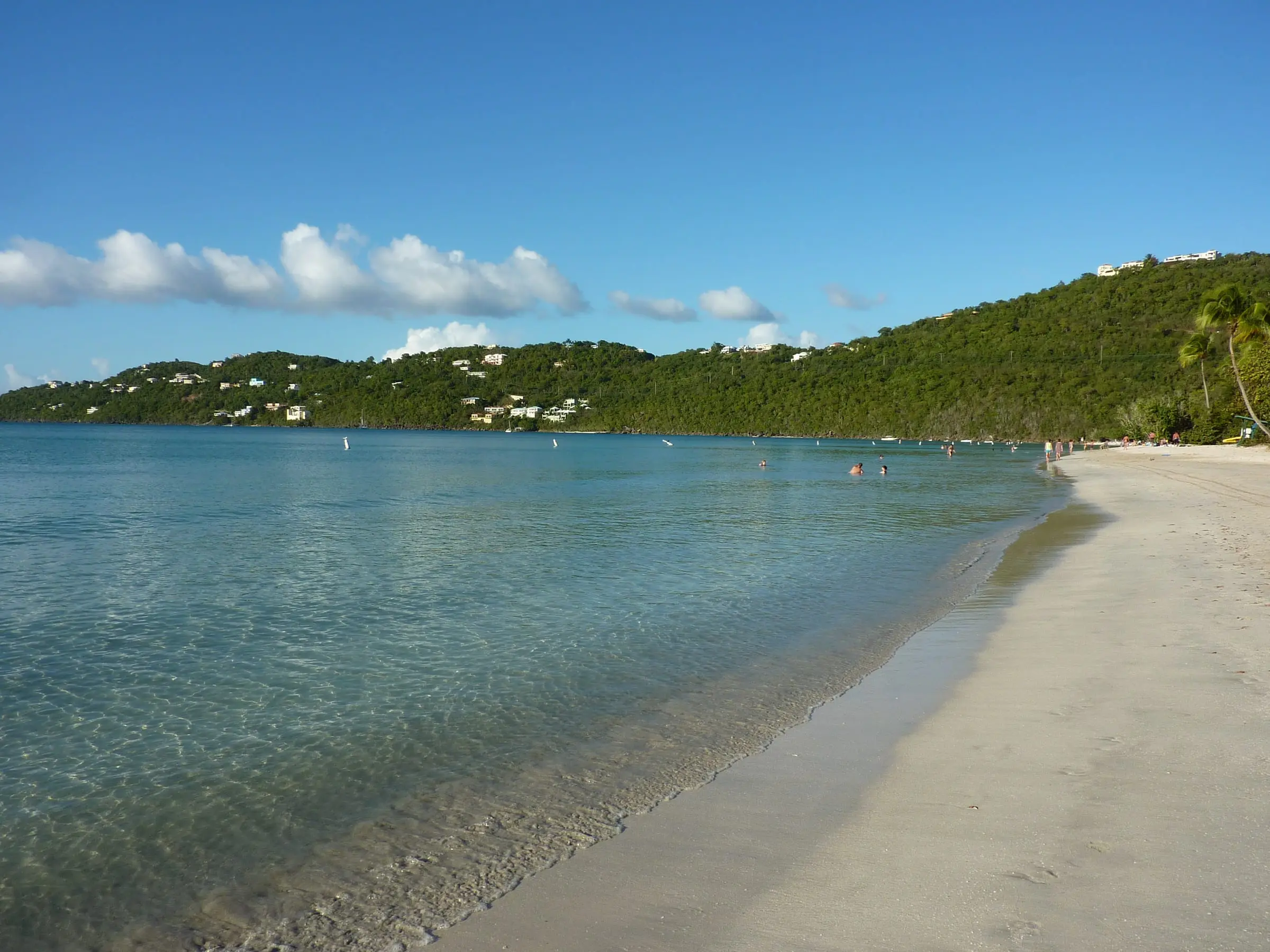
Photo: Jason P. Heym, CC BY-SA 3.0

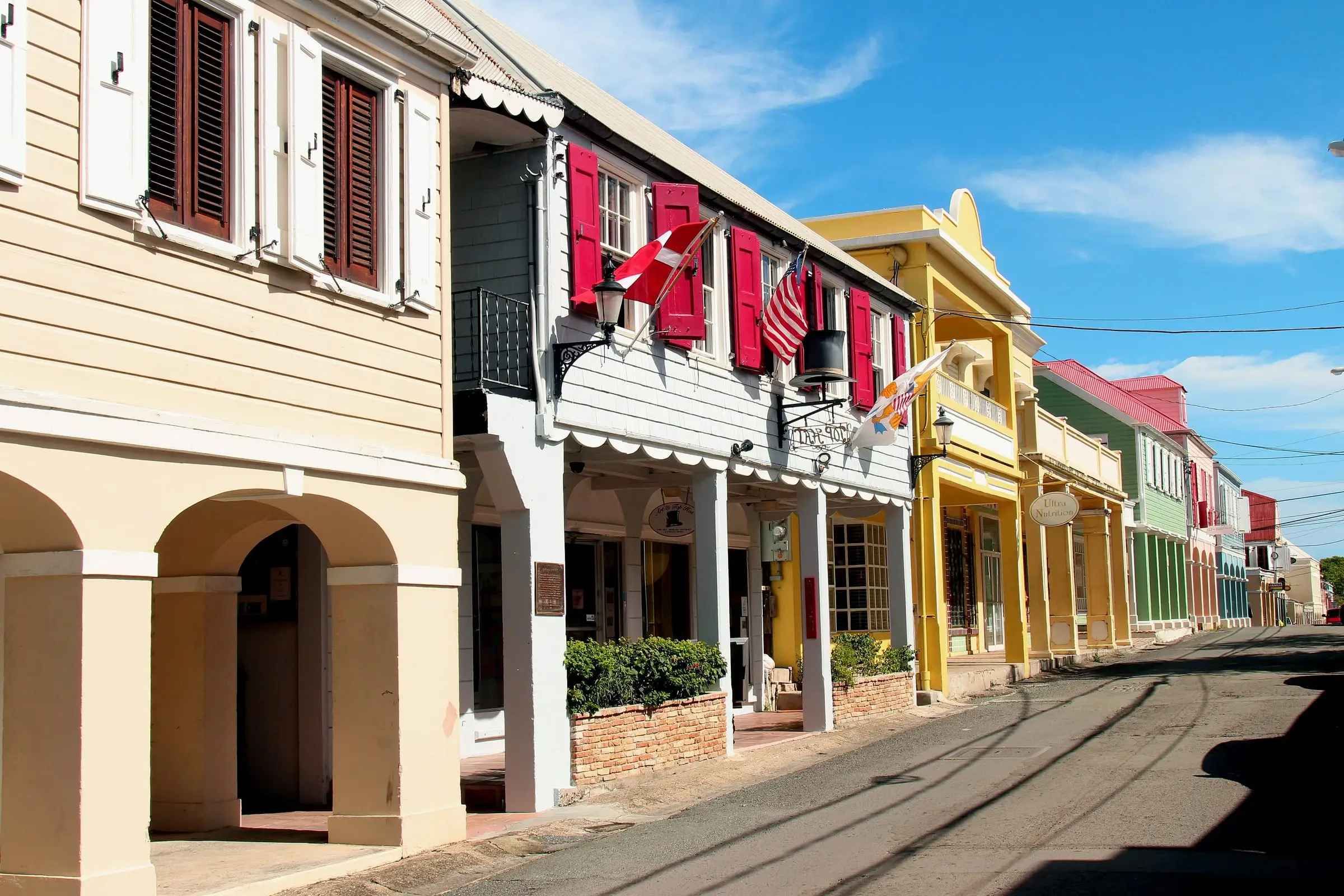
Photo: Navin75, CC BY-SA 2.0
Questions
Do I need an attorney to buy property in the USVI?
The Virgin Islands Real Estate Commission's rules say a broker or salesperson should recommend that each purchaser retain an attorney to review the marketability of the title and the other legal questions involved. Speak with a USVI real estate attorney before you sign a contract.
Where is a deed recorded in the USVI?
With the Recorder of Deeds in the Office of the Lieutenant Governor, which has an office on St. Croix and an office on St. Thomas that serves St. Thomas and St. John. Original deeds must be submitted directly to the office, not by e-recording.
Can I get flood insurance in the USVI?
FEMA lists the Territory of the Virgin Islands as a participating community in the National Flood Insurance Program. FEMA says there is typically a 30-day waiting period before a new policy takes effect, so talk to an insurance agent early.
Is this guide legal, tax or financial advice?
No. USVI Realty is an educational resource and does not represent buyers or sellers. Use this guide to prepare questions for licensed real estate professionals, attorneys, lenders, insurers and tax advisers.
Sources
- 2020 Island Areas Censuses: U.S. Virgin Islands, U.S. Census Bureau (accessed October 28, 2026)
- Table 1. Population of the United States Virgin Islands: 2010 and 2020, U.S. Census Bureau (accessed October 28, 2026)
- TIGER/Line Shapefiles 2025, U.S. Virgin Islands estates (land area), U.S. Census Bureau (accessed October 28, 2026). Land area cross-checked against the TIGERweb county-equivalent land area for each island.
- TIGERweb: land area of St. Thomas, St. John and St. Croix islands, U.S. Census Bureau (accessed October 28, 2026)
- TIGER/Line Shapefiles: Estate series information (metadata), U.S. Census Bureau (accessed October 28, 2026)
- Virgin Islands National Park, National Park Service (accessed October 28, 2026)
- Virgin Islands National Park: Directions, National Park Service (accessed October 28, 2026)
- What's the difference between a prequalification letter and a preapproval letter?, Consumer Financial Protection Bureau (accessed October 28, 2026)
- What is a Loan Estimate?, Consumer Financial Protection Bureau (accessed October 28, 2026)
- FHFA Announces Conforming Loan Limit Values for 2026, Federal Housing Finance Agency (accessed October 28, 2026)
- Department of Licensing and Consumer Affairs: boards and License Search, Virgin Islands Department of Licensing and Consumer Affairs (accessed October 28, 2026)
- Requirements for Real Estate Commission Licensure and Examination, Virgin Islands Department of Licensing and Consumer Affairs (accessed October 28, 2026)
- License Search, Virgin Islands Department of Licensing and Consumer Affairs (accessed October 28, 2026)
- Virgin Islands Real Estate Commission Rules and Regulations, Virgin Islands Real Estate Commission (accessed October 28, 2026)
- Banking, Insurance and Financial Regulation, Office of the Lieutenant Governor, U.S. Virgin Islands (accessed October 28, 2026)
- Mortgage key terms, Consumer Financial Protection Bureau (accessed October 28, 2026)
- Schedule a home inspection, Consumer Financial Protection Bureau (accessed October 28, 2026)
- Recorder of Deeds, Office of the Lieutenant Governor, U.S. Virgin Islands (accessed October 28, 2026)
- What is owner's title insurance?, Consumer Financial Protection Bureau (accessed October 28, 2026)
- 2026 Real Property Tax Delinquency List, Office of the Lieutenant Governor, U.S. Virgin Islands (accessed October 28, 2026)
- Flood Maps, Federal Emergency Management Agency (accessed October 28, 2026)
- Community Status Book Report: Virgin Islands, Federal Emergency Management Agency (accessed October 28, 2026)
- Flood Insurance, Federal Emergency Management Agency (accessed October 28, 2026)
- Your Health and Cisterns: A USVI Comprehensive Guide (January 2024), Virgin Islands Department of Planning and Natural Resources and U.S. Environmental Protection Agency (accessed October 28, 2026)
- Cisterns in the U.S. Virgin Islands (EPA Region 2 fact sheet, August 11, 2021), U.S. Environmental Protection Agency (accessed October 28, 2026)
- Virgin Islands Water and Power Authority, Virgin Islands Water and Power Authority (accessed October 28, 2026)
- Division of Permits: What We Do, Virgin Islands Department of Planning and Natural Resources (accessed October 28, 2026)
- Coastal Zone Management: What We Do, Virgin Islands Department of Planning and Natural Resources (accessed October 28, 2026)
- Lieutenant Governor Roach encourages residents to Be Ready/Be Insured for the 2026 hurricane season, Office of the Lieutenant Governor, U.S. Virgin Islands (accessed October 28, 2026)
- Bulletin 2023-02: Availability of Windstorm Insurance Coverage in the Territory, Office of the Lieutenant Governor, Division of Banking, Insurance and Financial Regulation (accessed October 28, 2026)
- Tropical Cyclone Climatology, NOAA National Hurricane Center (accessed October 28, 2026)
- What is a Closing Disclosure?, Consumer Financial Protection Bureau (accessed October 28, 2026)
- Recording Requirements (Sales Valuation Affidavit and new deeds), Office of the Lieutenant Governor, U.S. Virgin Islands (accessed October 28, 2026)
- BA Properties Inc. v. Government of the Virgin Islands, No. 00-2771 (2002), U.S. Court of Appeals for the Third Circuit (accessed October 28, 2026)
- Office of the Tax Assessor, Office of the Lieutenant Governor, U.S. Virgin Islands (accessed October 28, 2026)
- Office of the Tax Collector, Office of the Lieutenant Governor, U.S. Virgin Islands (accessed October 28, 2026)
- Lieutenant Governor Roach reminds taxpayers of real property tax payment deadline (2024), Office of the Lieutenant Governor, U.S. Virgin Islands (accessed October 28, 2026)
- Homestead Tax Credit Requirements, Office of the Lieutenant Governor, Office of the Tax Assessor (accessed October 28, 2026)